
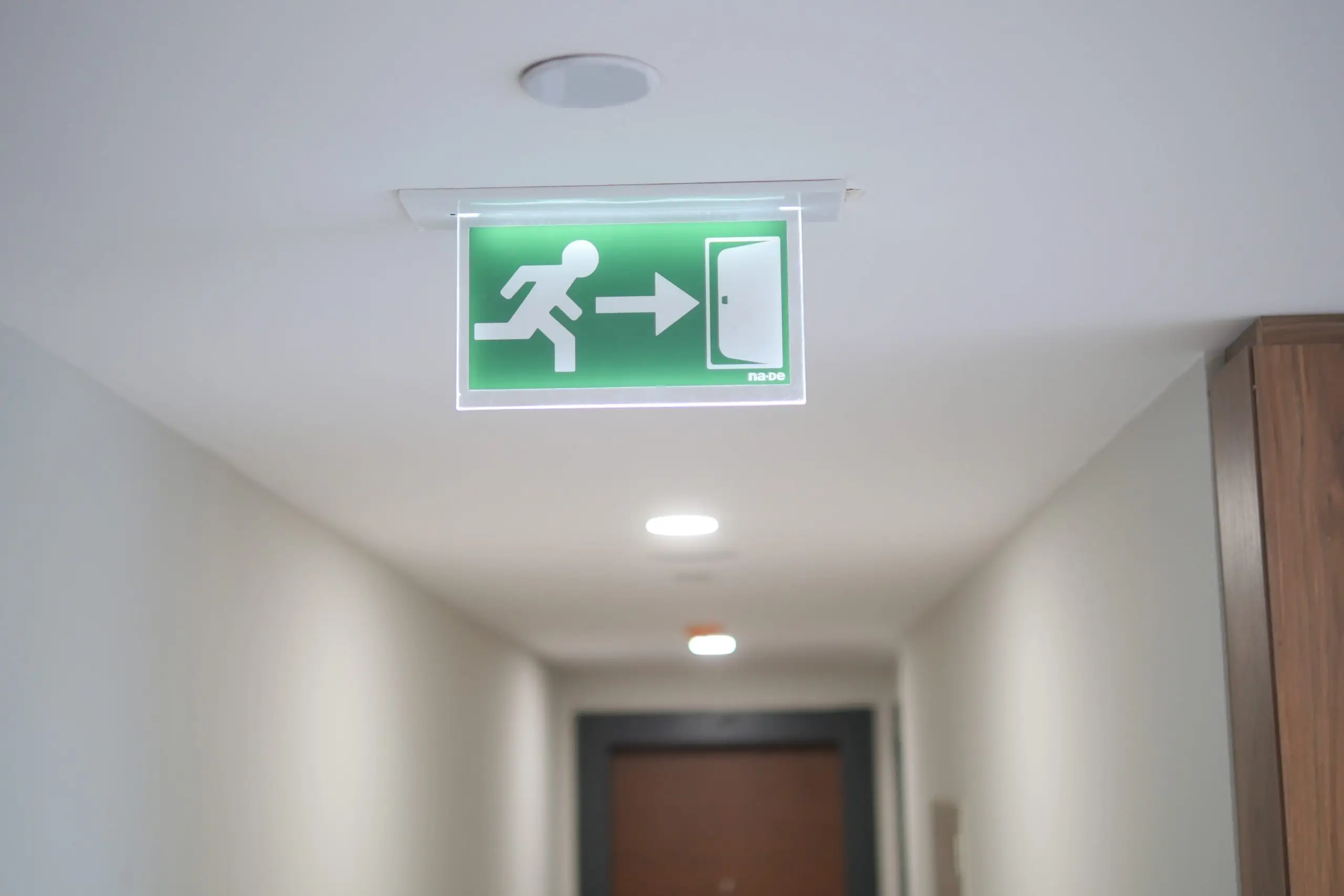
Emergency lighting has always been a fundamental life-safety requirement in residential blocks…particularly within communal corridors, stairwells, landings and entrance lobbies.
For many years, compliance has centred on a simple question: does the emergency lighting come on during a power cut, and does it stay on for the required duration?
Routine monthly functional tests and annual full-duration tests remain essential and form the backbone of emergency lighting maintenance.
However, across updated guidance and what is increasingly being raised through fire risk assessments and audits, the focus is shifting. The question is no longer just “does it operate?”, but “does it still provide enough usable light along the escape route?”
From operation to real-world performance
Routine testing confirms that emergency lights switch into emergency mode and remain operational. What it doesn’t confirm is how much light is actually being delivered at floor level, where people walk during an evacuation.
Over time, emergency lighting performance can reduce gradually and often go unnoticed:
- light output reduces as fittings age
- batteries lose capacity
- diffusers discolour
- fittings are altered, obscured or knocked
- buildings change – doors are replaced, corridors reconfigured, finishes upgraded
As a result, systems that once met design expectations can fall below current performance benchmarks without showing any obvious fault during routine testing.
Why full-width escape route lighting is important in blocks
There is also a growing emphasis on ensuring adequate illumination across the full usable width of escape routes, not just the centre line.
In residential blocks, this is particularly relevant. Communal routes include alcoves, door recesses, changes in width, stair cores and areas where trip hazards commonly exist. These are often the first places where lighting levels become marginal — even when a system appears compliant at a glance.
The role of photometric (LUX) verification
Alongside routine testing, there is now an increasing expectation for periodic photometric verification, often referred to as a LUX survey.
A LUX survey measures light levels at floor level while the emergency lighting is operating in emergency mode. It provides a clearer picture of whether illumination across escape routes remains adequate under real conditions.
This process does not replace monthly or annual testing. Instead, it complements it by assessing performance rather than basic operation. As a guide, verification is often recommended at least every five years, or sooner where:
- buildings have undergone refurbishment or layout changes
- systems are ageing
- concerns have been raised through fire risk assessments
- recurring faults or poor lighting levels have been identified
Crucially, verification allows issues to be identified proactively. In many cases, it confirms systems remain suitable. Where shortcomings are found, it enables improvements to be planned in a controlled and proportionate way, rather than reactively.
What this means for managing agents and responsible persons
For those managing leasehold blocks and estates, this is not about creating additional burden. Existing testing regimes remain necessary and valid, but they may no longer provide a complete picture of system performance.
Understanding whether emergency lighting continues to perform as intended is becoming an increasingly important part of demonstrating due diligence. Reviewing whether a block has ever undergone photometric verification, and considering how changes over time may have affected lighting performance, is a logical next step for many communal systems.
A practical approach
At Future Group, we support managing agents and building owners by explaining these expectations in clear, practical terms. Photometric verification is not about assuming non-compliance – it is about gaining visibility.
In many cases, measured results confirm that systems remain effective. In others, they highlight targeted improvements that can be planned sensibly, improving safety while avoiding unnecessary disruption or cost.
As expectations continue to evolve, being able to demonstrate that emergency lighting not only operates, but continues to perform as intended, is becoming increasingly important across the residential sector.
If you’re unsure how this applies to your buildings, or whether your current arrangements should be reviewed, seeking competent technical guidance can help provide clarity.